 Even the most humble classic car restoration or maintenance workshop needs power. Power that lights, heats or cool the building and power to operate the many pieces of equipment and tools required in the everyday tasks that need to be carried out.
If there are no integral sources of power available for the workshop then the best, and indeed only, alternative is to find an alternative. And that alternative will more than probably be a portable power generator.
 Choosing which portable generator will most efficiently serve the needs of a classic car restoration workshop requires a lot of thought and planning so that a stable power supply is guaranteed.
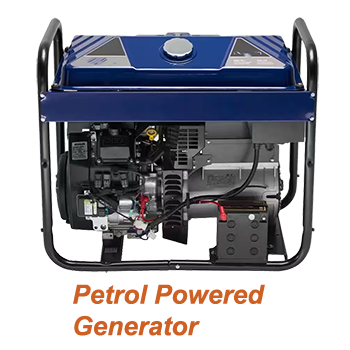
There are three choices to be made which are either:
- A Petrol-powered generator
- A Petrol-powered generator
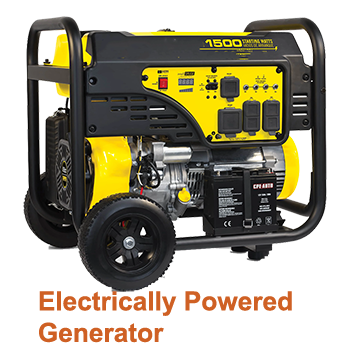
- An Electrically-powered generator
When making that choice the following factors must be considered:
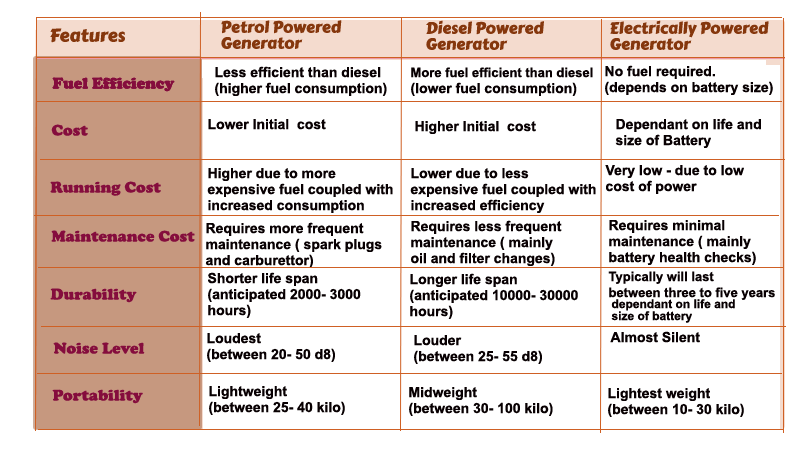
Power Output Required: It is important before investing in a portable generator to evaluate, as accurately as possible, the total wattage of the tools that will be in general use. An average restoration of maintenance workshop will normally require generator with a capacity ranging from 5,000 to 7,500 watts.
To help a better understanding of the individual needs before investing please refer to our feature chart.
 Once the choice of which generator best suits the purpose. the next choice is no less significant. That is where to position the generator:
In any workshop, it is important to pick the best possible spot in terms of efficiency and safety. If it is possible, and even compulsory in the case of a diesel-powered generator, the unit is placed outside the building or at least in a very ventilated area to prevent the buildup of carbon monoxide.
If placed outdoors, in generator cover must be used to safeguard the unit from rain and dust.
 When the generator is in place and running, the next important step is to institute a set of working procedures in terms of safety. It is good advice to install a manual transfer switch that will ensure the safe powering of essential circuits in the workshop. If there is a need for extension cords to bring power to heavier equipment in the workshop, heavy-duty, outdoor rated extension cords should be used to reduce power loss.
For petrol or diesel driven generators it is important to establish a safe fuel management safe policy. All flammable fuels must be in approved containers, stored away from heat sources. To avoid running out of fuel, the generator must be consistently refuelled.
In addition, oil and filter changes must be performed regularly-according to the manufacturer's recommendations. Spark plugs and filters must be checked and replaced to ensure optimal performance.
If a heavy-duty diesel generator is being used, it should be positioned behind a soundproof wall or enclosure that includes ventilation. Rubber feet or pads should be added that should effectively minimise vibration and noise transmission.
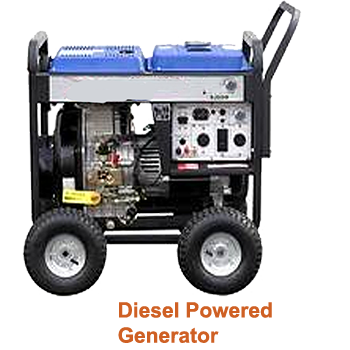
 If a diesel generator is installed and is working within or close to the workshop it is very worthwhile to consider installing a carbon monoxide detector to measure levels of these potentially fatal fumes.
If an electrically powered generator is installed it must be properly grounded to mitigate electrical hazards.
A fire extinguisher should be readily accessible in close proximity to the generator.
The workshop should appoint a safety officer to regularly carry out a regular inspect that to ensure that the generator is intact and there are no broken or loose parts and no torn wires.
Before operation, a moment should be taken to check and tighten screws and that the generator is clean and that staff know how to follow the manufacturer's operating instructions.
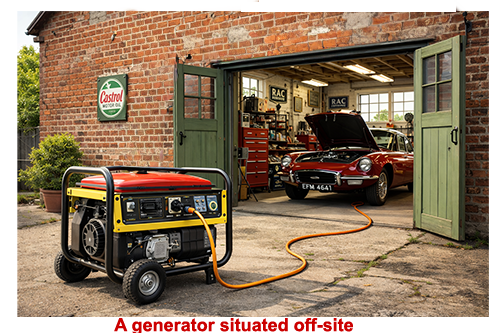 The generator must be placed securely on a flat and horizontal surface, as a generator vibrates by nature and may move a bit while operating. The equipment must be placed in a way that there is no risk of it falling or tipping over.
Placing the generator in an inadequately ventilated area may cause the accumulation of toxic gases that can damage the generator and even harm the operator.
For generators with an electric start, it is recommended to disconnect the battery after finishing work if a long time is expected to pass until the next use. There is an option to use an automatic charger while the generator is not in use to keep the battery ready for operation.
Operators should take the time and be sure to learn and carefully observe the recommended maintenance intervals for the type of generator chosen and service it accordingly, so as to ensure its maximal operation and lifespan!

- Vehicle Lifting and Support Equipment
- Electrical and Power Infrastructure
- Welding and Fabrication Equipment
- Metalworking and Fabrication Equipment
- Cleaning, Degreasing and Preparation Equipment
- Engine and Mechanical Workshop Equipment
- Bodywork,Paint and Finishing Equipment
- Sanding, Preparation and Rust Control Equipment
- Tyre, Wheel and Suspension Equipment
- Fuel, Cooling and Fluid Handling Systems
- Exhaust and Emissions Equipment
- Electrical and Diagnostic Equipment
- Storage and Workshop Furniture
- Safety, Environmental and Compliance Equipment
- Comfort, Workflow and Support Infrastructure
-
uph4